

🎓 Study in Romania: A Complete Guide for Pakistani Students
Romania is becoming an increasingly attractive destination for Pakistani students looking for affordable European education, internationally recognized degrees, English-taught programmes, a safe student environment and access to the Schengen Area.
As a European Union country and a full Schengen member, Romania offers international students the opportunity to study in Europe while enjoying easier short-term travel across other Schengen countries.
Romanian universities offer a wide range of programmes in fields such as Computer Science, Engineering, Business, Medicine, Dentistry, Data Science, Economics, Tourism, Agriculture, Architecture and many more.
For Pakistani students, Romania can be an excellent option for combining quality education, reasonable costs and European exposure.
🌍 Why Choose Romania for Higher Education?
Romania offers several advantages for international students.
Key Benefits of Studying in Romania
- 🎓 Internationally recognized European degrees
- 🇪🇺 European Union country
- 🇪🇺 Full Schengen country
- 💰 Affordable tuition fees
- 📚 English-taught programmes
- 🏫 Wide range of universities and programmes
- 👨🎓 Safe and student-friendly environment
- 💼 Part-time work opportunities
- 🎓 Scholarship opportunities
- 💶 Relatively affordable living costs
- ✈️ Travel opportunities across Schengen Europe
- 🌍 Multicultural European environment
- 🚀 Career opportunities after graduation
Romania’s combination of affordable education and European opportunities makes it an increasingly popular choice among international students.
📚 English-Taught Programmes in Romania
Pakistani students can find many programmes taught in English at Romanian universities.
Popular fields include:
- Computer Science
- Information Technology
- Cybersecurity
- Engineering
- Business Administration
- Finance & Accounting
- Economics
- Data Science
- Artificial Intelligence
- Medicine
- Dentistry
- Agriculture
- Architecture
- Tourism & Hospitality
- Management
- International Business
English-language requirements vary according to the university and programme.
Some universities may accept:
- IELTS
- TOEFL
- PTE
- Other recognized English proficiency evidence
Students should check the exact requirements of their selected programme.
🎓 Bachelor’s Degree Admission Requirements
For Bachelor’s admission, students generally need:
- HSSC/Intermediate or equivalent qualification
- Academic certificates
- Academic transcripts
- Valid passport
- English-language evidence where required
- Programme-specific prerequisites
- Other documents requested by the university
The exact academic requirements can vary between universities and programmes.
🎓 Master’s Degree Admission Requirements
For Master’s admission, applicants generally need:
- A recognized Bachelor’s degree
- Academic transcripts
- Valid passport
- English-language evidence where required
- CV where requested
- Relevant academic background
- Additional programme-specific documents
Some universities may also consider relevant professional experience depending on the programme.
📅 Intakes in Romania
The September/October intake is the main admission period for many Romanian universities.
Some institutions and programmes may have different application schedules or additional intakes.
Students should ideally begin their preparation 6–8 months before the intended intake.
Early preparation gives students enough time for:
- University selection
- Application submission
- Admission processing
- Document preparation
- Legalization
- Acceptance documentation
- Financial planning
- Visa preparation
- Accommodation
- Travel arrangements
💰 Tuition Fees in Romania
Romania is considered one of the more cost-effective European study destinations.
Tuition fees vary depending on the university, programme and field of study.
Bachelor’s Programmes
Approximately €2,500–€6,000 per year for many programmes.
Master’s Programmes
Approximately €2,500–€7,000 per year for many programmes.
Medicine & Dentistry
Fees can be significantly higher and may reach approximately €6,000–€10,000 or more per year, depending on the university and programme.
Actual tuition fees must always be confirmed according to the selected university and programme.
💶 Cost of Living in Romania
Romania offers relatively affordable living costs compared with many Western European countries.
A reasonable planning estimate is approximately:
💰 €450–€800 per month
Actual expenses depend on the city, accommodation and lifestyle.
Typical expenses can include:
- 🏠 Accommodation
- 🍽️ Food
- 🚇 Transportation
- 📱 Internet and mobile services
- 🩺 Health insurance
- 📚 Study materials
- 🎭 Personal expenses
Bucharest and other major cities can be more expensive than smaller university cities.
🏠 Accommodation Options
International students can choose from several accommodation options:
- University dormitories
- Student residences
- Shared apartments
- Private apartments
- Homestay arrangements
University accommodation can be an economical option for students who want to reduce their monthly expenses.
Students should arrange accommodation early, particularly for popular cities and universities.
🎓 Scholarships in Romania
Romania provides several scholarship opportunities for eligible international students.
Potential opportunities may include:
- Romanian Government scholarships
- University scholarships
- Merit-based scholarships
- Erasmus+ opportunities
- Faculty-specific scholarships
- Tuition fee discounts
Scholarship availability and eligibility requirements can change from year to year.
Students should carefully assess the requirements, deadlines and documents for each scholarship opportunity.
💼 Can International Students Work in Romania?
Yes. International students can have the opportunity to work while studying in Romania, subject to the applicable residence and employment conditions.
For non-EU students, student employment is generally permitted on a part-time basis, with current rules allowing up to 6 hours per day under the applicable conditions.
This can help students gain:
- International work experience
- Professional exposure
- Additional income
- Communication skills
- European workplace experience
Students should always ensure that employment remains compliant with their immigration status.
🚀 Post-Study Opportunities in Romania
Romania can also provide opportunities for graduates who want to continue their professional journey after completing their studies.
Eligible graduates may be able to extend their residence rights for a limited period to:
- Search for employment
- Complete employment formalities
- Explore eligible business opportunities
The exact conditions depend on the student’s residence status and applicable immigration regulations.
Romania – A Full Schengen Country
One of Romania’s biggest advantages is its position within the Schengen Area.
Romania became a full Schengen member on 1 January 2025.
This makes Romania particularly attractive for students who want to experience European mobility.
Students with valid Romanian residence documentation can generally travel to other Schengen countries for short stays according to applicable rules.
✈️ Students can explore destinations such as:
- 🇫🇷 France
- 🇩🇪 Germany
- 🇮🇹 Italy
- 🇪🇸 Spain
- 🇦🇹 Austria
- 🇳🇱 Netherlands
- 🇭🇺 Hungary
- 🇨🇿 Czech Republic
- 🇬🇷 Greece
- 🇵🇱 Poland
⚠️ Important
Schengen travel does not automatically give a student the right to work, study or permanently live in another Schengen country.
📝 Step-by-Step Romania Admission Process
Step 1 – Profile Assessment
Review your:
- Academic qualifications
- Percentage/CGPA
- Previous study background
- English proficiency
- Study gap
- Financial profile
- Preferred field
Step 2 – University & Programme Selection
Choose suitable Romanian universities and programmes according to your academic and career profile.
Step 3 – Prepare Documents
Collect all academic, identification and supporting documents.
Step 4 – Submit University Application
Submit your application according to the university’s admission procedure.
Step 5 – University Evaluation
The university evaluates your academic profile and supporting documents.
Step 6 – Receive Acceptance
After successful evaluation, obtain the required acceptance documentation.
Step 7 – Prepare Visa File
Prepare financial, accommodation, insurance, police clearance and other required documents.
Step 8 – Apply for Student Visa
Submit the required long-stay student visa application.
Step 9 – Visa Decision
Wait for the visa decision and complete any additional requirements if requested.
Step 10 – Travel to Romania
After visa approval, arrange your travel and accommodation.
Step 11 – Residence Permit
After arrival, complete the required residence-permit formalities.
📑 Documents Required for University Admission
Common documents may include:
- CNIC
- Valid Passport
- Academic Certificates
- Academic Transcripts
- CV/Resume where required
- English proficiency evidence
- Recommendation letters where required
- Experience letter where applicable
- Passport-size photographs
- Motivation letter where required
- Other programme-specific documents
The exact document list varies according to the university and programme.
📜 Document Translation & Legalization
Students may need to prepare documents through:
- Official translation
- Notarization where required
- Authentication/legalization
- Apostille where applicable
The required procedure depends on the document and the requirements of the university and immigration authorities.
Students should ensure that documents are prepared correctly before submission.
💰 Financial & Bank Statement Requirements
Students need to demonstrate sufficient financial resources to support their studies and stay in Romania.
For planning purposes, the FAQ information commonly used by Pakistani applicants indicates approximately:
Bachelor’s
PKR 30–35 lakh
Master’s
PKR 35–40 lakh
Medicine/Dentistry
PKR 45–60 lakh
The actual financial requirement can vary according to tuition fees, duration of stay and individual circumstances.
A genuine and properly documented source of funds is extremely important.
🏦 How Old Should the Bank Statement Be?
A 6-month bank statement is generally preferred for demonstrating a stable financial history.
A longer and consistent financial history can make the financial profile stronger.
Students should avoid unexplained large deposits shortly before submitting a visa application.
The source of funds should be clear and supported with appropriate evidence.
👨👩👧 Who Can Sponsor My Studies?
Depending on the circumstances, financial support may come from:
- Father
- Mother
- Husband/Wife
- Brother
- Sister
- Legal guardian
- Other acceptable sponsor
Supporting evidence may include:
- Bank statements
- Income proof
- Tax documents
- Employment evidence
- Business documents
- Relationship documents
The relationship between the student and sponsor should be properly documented.
🏥 Medical Insurance
Medical insurance is an important part of the Romanian student visa and residence process.
Students should arrange appropriate insurance covering the required period and complying with the applicable immigration requirements.
👮 Police Character Certificate
A Police Character Certificate may be required for the student visa process.
Students should obtain the certificate from the relevant authority and prepare it according to the applicable translation and legalization requirements.
Romanian Student Visa Process
The general process can be summarized as:
University Admission → Acceptance Documentation → Financial Preparation → Visa File Preparation → Student Visa Application → Visa Decision → Travel → Residence Permit
Students should ensure that all financial, academic, accommodation, insurance and character documents are properly prepared before submitting their application.
🏙️ Popular Study Destinations in Romania
Bucharest
Romania’s capital city and an important centre for education, business and employment.
Cluj-Napoca
A major university and technology city with a strong student environment.
Iași
An important university city with a long academic tradition.
Timișoara
A major educational, business and technology centre in western Romania.
Brașov
A beautiful European city offering an attractive student and lifestyle environment.
The best city depends on the student’s programme, university and budget.
🎯 Popular Fields of Study in Romania
Romanian universities offer programmes in many popular fields, including:
- Computer Science
- Information Technology
- Artificial Intelligence
- Data Science
- Engineering
- Business
- Economics
- Finance
- Medicine
- Dentistry
- Tourism
- Architecture
- Agriculture
- Management
Students should choose their field according to their previous education, career objectives and realistic admission prospects.
⭐ Popular Romanian Universities
Some well-known Romanian institutions include:
- University of Bucharest
- Babeș-Bolyai University
- Alexandru Ioan Cuza University
- Politehnica University of Bucharest
- Gheorghe Asachi Technical University of Iași
- West University of Timișoara
- Leading medical universities across Romania
The best university depends on the student’s selected field, academic profile, tuition budget and career goals.
⏰ When Should Pakistani Students Apply?
Students should ideally begin their preparation 6–8 months before the intended intake.
Early preparation helps with:
- University selection
- Application submission
- Admission processing
- Document preparation
- Financial planning
- Legalization
- Visa preparation
- Accommodation
- Travel arrangements
Starting early can significantly reduce the risk of delays.
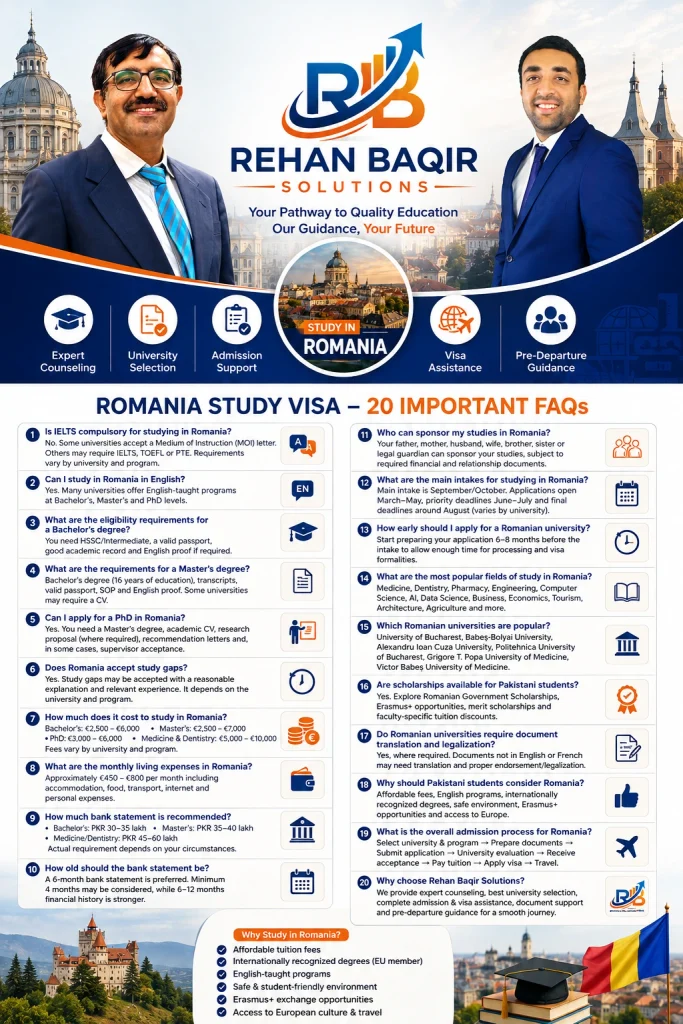
❓ Frequently Asked Questions – Study in Romania
1. Is IELTS compulsory for studying in Romania?
IELTS is not universally compulsory for every Romanian university. Some universities may accept an MOI letter, while others may require IELTS, TOEFL, PTE or another recognized form of English proficiency.
Requirements depend on the university and programme.
2. Can I study in Romania in English?
Yes. Many Romanian universities offer English-taught Bachelor’s and Master’s programmes in fields such as Business, Engineering, Computer Science, Medicine, Data Science and other disciplines.
3. What are the eligibility requirements for a Bachelor’s degree?
Students generally need HSSC/Intermediate or an equivalent qualification, a valid passport, an acceptable academic record and English-language evidence where required.
4. What are the requirements for a Master’s degree?
Applicants generally need a recognized Bachelor’s degree, academic transcripts, a valid passport and English-language evidence where required.
Some universities may also request a CV or additional supporting documents.
5. Does Romania accept study gaps?
Study gaps can be considered when supported by a reasonable explanation and relevant supporting evidence where applicable.
Each university and visa application is assessed individually.
6. How much does it cost to study in Romania?
Tuition varies according to the university and programme.
A general planning range is approximately:
Bachelor’s: €2,500–€6,000 per year
Master’s: €2,500–€7,000 per year
Medicine and Dentistry can be considerably more expensive.
7. What are the monthly living expenses in Romania?
A reasonable planning estimate is approximately €450–€800 per month, depending on accommodation, city and lifestyle.
8. How much bank statement is recommended?
The commonly used planning figures for Pakistani applicants are:
- Bachelor’s: PKR 30–35 lakh
- Master’s: PKR 35–40 lakh
- Medicine/Dentistry: PKR 45–60 lakh
Actual financial requirements can vary according to the individual case.
9. How old should the bank statement be?
A 6-month bank statement is preferred. A longer and consistent financial history can provide stronger evidence of genuine financial capacity.
10. Who can sponsor my studies in Romania?
Depending on the circumstances, a father, mother, husband/wife, brother, sister, legal guardian or another acceptable sponsor may support the student’s studies.
Proper financial and relationship documentation should be provided.
11. What are the main intakes for studying in Romania?
The main intake for many programmes is September/October.
Individual universities and programmes may have different admission schedules.
12. How early should I apply for a Romanian university?
Students should ideally begin preparing 6–8 months before the intended intake.
This provides enough time for admission, documents, financial preparation and visa processing.
13. What are the most popular fields of study in Romania?
Popular fields include:
- Medicine
- Dentistry
- Engineering
- Computer Science
- Artificial Intelligence
- Data Science
- Business
- Economics
- Tourism
- Architecture
- Agriculture
14. Which Romanian universities are popular?
Popular institutions include the University of Bucharest, Babeș-Bolyai University, Alexandru Ioan Cuza University, Politehnica University of Bucharest, Gheorghe Asachi Technical University of Iași and West University of Timișoara.
Romania also has several well-known medical universities.
15. Are scholarships available for Pakistani students?
Yes. Eligible international students can explore Romanian Government scholarships, university scholarships, merit-based opportunities and Erasmus+ options.
Scholarship eligibility and deadlines vary.
16. Do Romanian universities require document translation and legalization?
Yes, where required.
Documents may need official translation, notarization, authentication, legalization or apostille depending on the university and immigration requirements.
17. Why should Pakistani students consider Romania?
Romania offers:
- Affordable tuition fees
- English-taught programmes
- European degrees
- EU membership
- Full Schengen membership
- Relatively affordable living costs
- Scholarship opportunities
- Safe and student-friendly cities
- European travel opportunities
18. Can international students work in Romania?
Yes. Eligible non-EU students can work under the applicable student residence and employment rules. Current rules generally allow student employment on a part-time basis.
19. What is the overall admission process for Romania?
The general process is:
Select University & Programme → Prepare Documents → Submit Application → University Evaluation → Receive Acceptance → Prepare Visa File → Apply for Visa → Travel to Romania → Obtain Residence Permit
20. Why choose Rehan Baqir Solutions?
Rehan Baqir Solutions provides professional guidance for:
- 🎓 Profile Assessment
- 🏫 University & Programme Selection
- 📑 Admission Application
- 📜 Document Preparation
- 💰 Financial Documentation Guidance
- 🇷🇴 Romania Student Visa Guidance
- 🛂 Visa File Preparation
- ✈️ Pre-Departure Guidance
Our goal is to make the Romania study process more organized, professional and easier to manage.
🚀 Start Your Romania Study Journey with Rehan Baqir Solutions
Planning to study in Romania can be time-consuming and confusing when you have to manage university selection, applications, documents, financial requirements and visa preparation on your own.
Rehan Baqir Solutions provides professional guidance throughout the process, helping students save valuable time, avoid costly mistakes and manage their applications more efficiently.
From choosing the right programme to admission and visa preparation, our experienced team is here to make your Romania study journey simpler, smoother and more professionally managed.
Start early. Save time and money. Let the professionals guide you towards your European education goals. 🎓✈️
⚠️ Important Disclaimer
University admission criteria, tuition fees, visa requirements, financial requirements, work rights, residence rules and immigration policies may change over time.
Final admission and visa decisions are made by the relevant university and Romanian authorities. Students should ensure that their applications are prepared according to the rules applicable at the time of application.