
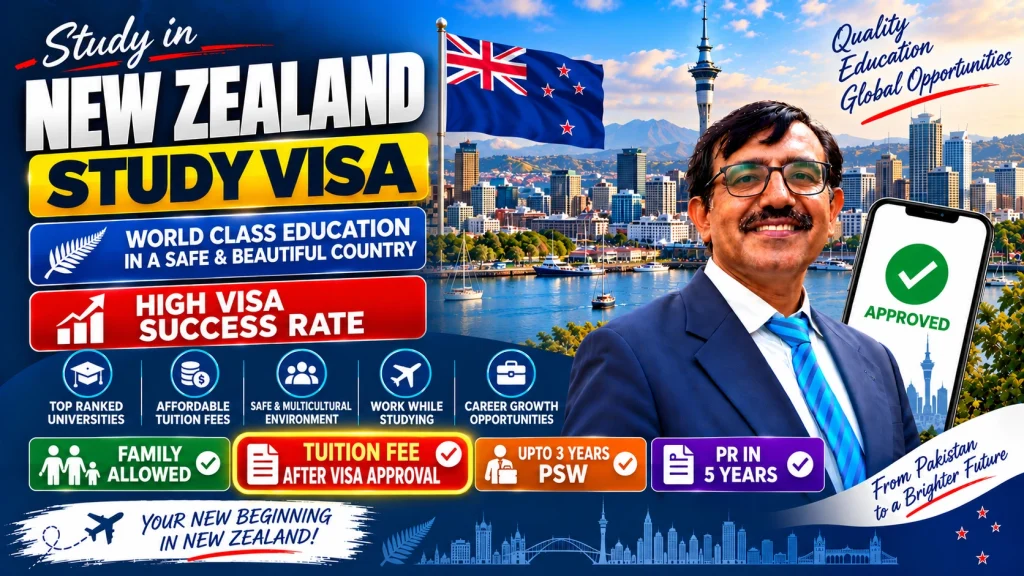
🎓 Study in New Zealand: A Complete Guide for Pakistani Students
New Zealand is becoming an increasingly attractive destination for Pakistani students looking for internationally recognized education, a safe and multicultural environment, practical study options, part-time work opportunities and strong post-study career pathways.
New Zealand offers a wide range of Bachelor’s and Master’s programmes through universities, institutes of technology and other approved education providers. International students can also benefit from post-study work opportunities, while eligible students may be able to bring family members under the relevant immigration rules.
One of the most attractive features for students applying from outside New Zealand is the Approval in Principle (AIP) option. Eligible applicants can choose to pay their tuition fees after receiving approval in principle, rather than paying the full tuition amount before the visa decision.
🌏 Why Choose New Zealand for Higher Education?
New Zealand offers an excellent combination of quality education and an attractive international student environment.
Key advantages include:
- 🌍 Globally recognized qualifications
- 🎓 High-quality universities and education providers
- Safe and multicultural society
- 💼 Opportunities to work while studying
- 🚀 Post-study work opportunities of up to 3 years, depending on qualification
- 👨👩👧 Family visa options for eligible students
- 💰 Option to pay tuition fees after Approval in Principle (AIP)
- 🌱 Potential pathways towards residence for eligible skilled graduates
- ✈️ International exposure and career opportunities
📚 English-Taught Programmes in New Zealand
New Zealand offers a large selection of programmes taught in English.
Pakistani students can explore programmes in areas such as:
- Business Administration
- Accounting & Finance
- Information Technology
- Computer Science
- Cybersecurity
- Engineering
- Construction & Quantity Surveying
- Healthcare
- Hospitality & Tourism
- Architecture
- Digital Design
- Management
- Data and technology-related fields
The exact entry requirements depend on the university, programme and qualification level.
🎓 Bachelor’s & Master’s Admission Requirements
Bachelor’s Degree
Students generally need a recognized Higher Secondary School qualification, such as Intermediate/HSSC or an equivalent qualification.
Universities may consider:
- Academic percentage
- Previous subjects
- English proficiency
- Programme-specific prerequisites
- Academic history
Master’s Degree
Applicants normally need a recognized Bachelor’s degree or equivalent qualification.
Universities may consider:
- Previous degree
- CGPA/percentage
- Relevant academic background
- Work experience where required
- English proficiency
- Programme-specific requirements
There is no single percentage requirement for every New Zealand university. Requirements can vary considerably by institution and programme.
📅 Intakes in New Zealand
New Zealand institutions may offer different intakes depending on the programme.
Common admission periods include:
🟢 February Intake
A major intake for many programmes.
🟢 July Intake
Another important intake available for selected programmes.
Some institutions and programmes may have additional starting dates.
Students should therefore begin the admission process several months before the intended intake.
💰 Tuition Fees in New Zealand
Tuition fees vary according to university, programme and qualification level.
As a general planning range:
Bachelor’s Degree
Approximately NZD 22,000–35,000 per year
Master’s Degree
Approximately NZD 30,000–45,000 per year
These are approximate figures and can be higher or lower depending on the institution and programme.
⭐ Important: Tuition Fee After Visa Approval
One of the major advantages for eligible offshore applicants is the Approval in Principle (AIP) option.
Students applying from outside New Zealand may choose to have their visa application assessed before paying the tuition fees. Once Immigration New Zealand grants Approval in Principle, the student can provide evidence that the required tuition fees have been paid so the visa can be finalized.
🔥 TUITION FEE CAN BE PAID AFTER APPROVAL IN PRINCIPLE
This can provide additional financial confidence because students can receive an immigration decision in principle before committing the tuition payment.
Important: AIP is not the same as final visa approval. The applicant must meet the remaining requirements and provide the requested tuition-fee evidence within the required timeframe.
🎓 Scholarships in New Zealand
Scholarships may be available for international students depending on the university, programme and academic profile.
Scholarships can be based on:
- Academic merit
- Programme
- University
- Previous academic performance
- Specific scholarship schemes
Students should check scholarship eligibility carefully because availability and funding vary.
🏠 Cost of Living in New Zealand
New Zealand requires international students to demonstrate sufficient funds for living expenses.
For tertiary students, the current immigration financial requirement is approximately:
💰 NZD 22,000 per year for Main Applicant
This is separate from tuition fees.
Actual living expenses depend on:
- City
- Accommodation
- Food
- Transportation
- Lifestyle
- Health and insurance costs
Major cities may generally require a higher budget.
🏡 Accommodation Options
Students can choose from:
- University accommodation
- Student residences
- Shared apartments
- Private rentals
- Homestay arrangements
Students should arrange suitable accommodation and retain documentary evidence for their visa and travel planning where required.
💼 Can Students Work While Studying?
Yes. Eligible international students may be allowed to work up to 25 hours per week during study periods, subject to the conditions of their student visa. Some students may also have full-time work rights during scheduled holidays.
Students should always check the exact conditions written on their eVisa or visa approval letter.
The current adult minimum wage in New Zealand is NZD 23.95 per hour before tax, effective from 1 April 2026.
👨👩👧 Family Allowed – New Zealand
New Zealand provides family visa options for eligible international students.
Depending on the student’s qualification and circumstances, a student may be able to support:
- Partner/Spouse visa options
- Dependent child visa options
- Visitor visas for family members
The exact rights of a partner and children depend on the student’s qualification and immigration category. Therefore, “Family Allowed” does not mean that every student automatically receives the same family visa rights.
🚀 Post-Study Work Visa – Up to 3 Years
New Zealand provides attractive post-study opportunities for eligible graduates.
Depending on the qualification and study duration, a Post-Study Work Visa can allow eligible graduates to remain and work in New Zealand for up to 3 years.
For eligible degree-level qualifications, graduates can have broader work opportunities, while the conditions for other qualifications can differ.
This makes New Zealand particularly attractive for students who want to gain international work experience after completing their studies.
🟢 Green List & Career Opportunities
New Zealand’s Green List identifies occupations where there are skill shortages and where eligible workers may have pathways towards residence.
Fields such as:
- IT
- Engineering
- Healthcare
- Construction
- Selected technical occupations
may provide stronger long-term opportunities depending on the occupation and current immigration requirements.
However, being a graduate in a particular field does not automatically guarantee residence. Employment, qualification, salary, occupation and other immigration requirements must be satisfied.
🏡 PR in 5 Years – What Students Should Understand
New Zealand can offer long-term residence pathways for eligible skilled migrants, but Permanent Residence is not automatically granted after five years of study or residence.
A student may first move from study to post-study employment and then qualify for a suitable residence pathway if the relevant requirements are met.
Under current rules, a Permanent Resident Visa generally requires the applicant to have held a Resident Visa for at least 2 years and satisfy the relevant requirements.
Therefore, “PR in 5 years” should be understood as a potential long-term pathway, not a guaranteed outcome for every student.
📝 Step-by-Step New Zealand Admission & Visa Process
Step 1 – Profile Assessment
Review your academic background, percentage/CGPA, study gap, English proficiency and intended field.
Step 2 – Select Programme
Choose a suitable Bachelor’s or Master’s programme according to your academic and career profile.
Step 3 – University Application
Submit the required academic and supporting documents.
Step 4 – Receive Offer Letter
The university assesses the application and issues an offer if the student meets its requirements.
Step 5 – Prepare Visa File
Prepare financial, academic, character, medical and other supporting documents.
Step 6 – Apply for Student Visa
Submit the application to Immigration New Zealand.
Step 7 – Approval in Principle
Eligible offshore applicants may use the AIP process and pay tuition after approval in principle.
Step 8 – Pay Tuition Fee
After AIP, provide the required tuition-fee payment evidence within the specified timeframe.
Step 9 – Final Visa Approval
Once all remaining requirements are satisfied, the student visa can be finalized.
Step 10 – Travel to New Zealand
After receiving the visa, arrange accommodation, travel and arrival preparations.
📑 Documents Required for Admission
Common documents may include:
- Passport
- CNIC
- Academic certificates
- Academic transcripts
- Bachelor’s degree for Master’s applicants
- CV/Resume
- English language evidence
- Experience letter where applicable
- Recommendation letters where required
- Motivation/Personal Statement where required
- Passport-size photographs
- Previous immigration/travel history where applicable
Programme-specific requirements may vary.
🗣️ IELTS & English Language Requirements
English language requirements depend on the university and programme.
The FAQ material indicates that many institutions commonly consider:
Bachelor’s
Around IELTS 6.0 overall, with programme-specific requirements.
Postgraduate
Around IELTS 6.5 overall, with individual band requirements depending on the institution.
Other accepted evidence may include PTE Academic or other recognized English-language evidence, depending on the university.
Students should confirm the exact English requirement of their selected programme before applying.
💰 Financial Requirements & Bank Statement
For tertiary study, Immigration New Zealand currently requires evidence of approximately:
NZD 22,000 per year for living expenses for Main Applicant
NZD 15,000 per year for Spouse (If spouse is accompanying main applicant)
NZD 5,000 per year for each Child (If children are accompanying main applicant)
This amount is in addition to tuition fees.
Funds may be demonstrated through acceptable sources such as:
- Personal bank funds
- Acceptable sponsor
- Financial undertaking
- Scholarship
- Approved education loan
- Other acceptable evidence
The source of funds and financial history are important. Simply showing a large recent deposit without a credible explanation may create concerns.
🏦 How Long Should the Bank Statement Be Maintained?
A minimum financial history of around 3 months may be relevant depending on the evidence being provided, while maintaining a longer and consistent financial history is generally stronger.
For applicants using sponsorship or other financial arrangements, additional evidence may be required.
👨👩👧 Who Can Sponsor Education?
Depending on the circumstances, acceptable financial support may come from:
- Student’s own funds
- Parents
- Family members
- An acceptable sponsor
- Education loan
- Scholarship or other approved funding arrangements
The relationship with the sponsor and the genuine source of funds should be clearly documented.
🏦 Are Education Loans Accepted?
Yes. Education loans can be used where they meet the applicable requirements and are supported by appropriate documentation.
A proper loan sanction letter and evidence explaining the loan amount, security, repayment arrangements and related financial details may be required.
🩺 Medical & Health Insurance
International students may need to provide medical and/or chest X-ray evidence depending on their circumstances and length of stay.
Students must also maintain acceptable medical and travel insurance in accordance with their student visa and education-provider requirements.
👮 Police Clearance Certificate
A Police Character Certificate may be required depending on the applicant’s age, intended length of stay and immigration history.
Where required, the certificate should be obtained from the relevant authorities and prepared according to Immigration New Zealand’s document requirements.
⏳ New Zealand Student Visa Processing Time
Processing times can vary depending on the education provider, time of year, completeness of the application and individual circumstances.
Current Immigration New Zealand guidance encourages international students to apply around 3 months before their intended travel date, with applicants from Pakistan specifically advised to allow sufficient time because of application volumes.
Applying early is therefore strongly recommended.
💳 New Zealand Student Visa Cost
The current Fee Paying Student Visa starts from approximately NZD 850, although the amount payable can depend on the applicant’s location and applicable fees/levies.
Additional expenses may include:
- Medical examination
- Chest X-ray where required
- Police certificate
- Insurance
- Document preparation
- Translation/certification where required
- Air ticket
- Accommodation
✈️ Arrival in New Zealand
Before travelling, students should prepare:
- Passport
- Visa approval
- Offer/enrolment documents
- Accommodation confirmation
- Financial documents
- Insurance documents
- Emergency contact information
- Important academic records
Students should keep important documents accessible during travel.
🌿 Is New Zealand Good for Pakistani Students?
Yes, New Zealand can be an excellent choice for Pakistani students who want:
- Internationally recognized education
- English-medium programmes
- A safe and multicultural environment
- Work opportunities during study
- Post-study work opportunities
- Family options for eligible students
- Potential long-term residence pathways
- International career exposure
However, selecting the right programme and institution is extremely important.
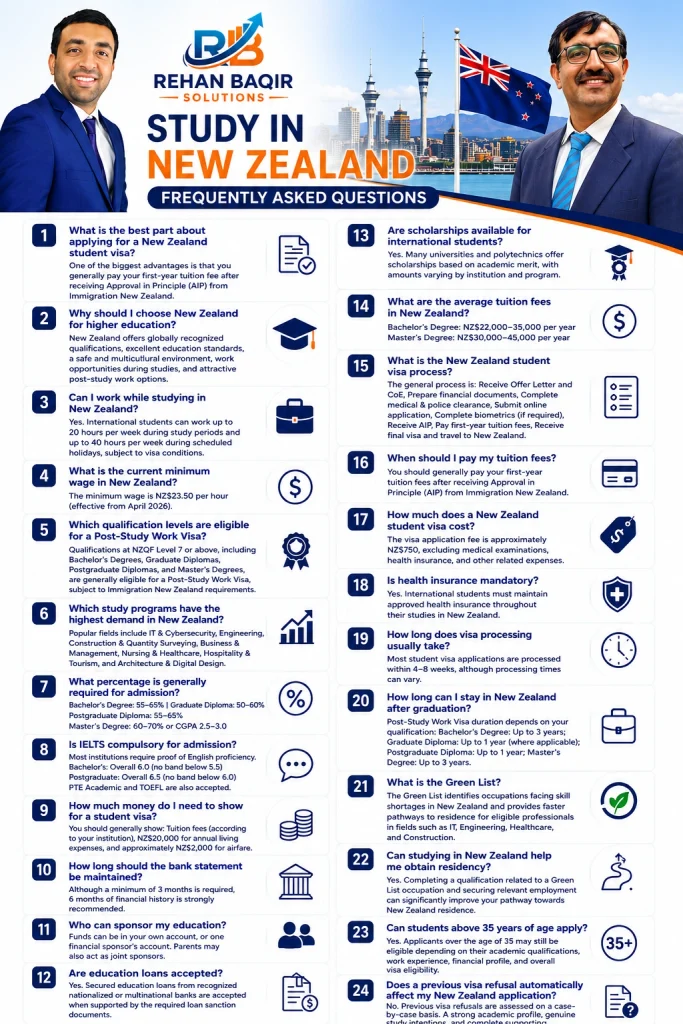
❓ Frequently Asked Questions – Study in New Zealand
1. What is the best part about applying for a New Zealand student visa?
One of the major advantages for eligible offshore applicants is that they may use the Approval in Principle (AIP) option and pay tuition fees after receiving approval in principle, before the final visa is issued.
2. Why should I choose New Zealand for higher education?
New Zealand offers globally recognized qualifications, quality education, a safe and multicultural environment, work opportunities during study and attractive post-study work options.
3. Can I work while studying in New Zealand?
Yes. Eligible students may work up to 25 hours per week during study periods, subject to their visa conditions.
4. What is the current minimum wage in New Zealand?
The adult minimum wage is currently NZD 23.95 per hour before tax, effective from 1 April 2026.
5. Which qualification levels are eligible for a Post-Study Work Visa?
Eligibility depends on the qualification, its level and the applicable immigration rules. Eligible graduates may receive a Post-Study Work Visa for a period of up to 3 years depending on their qualification and circumstances.
6. Which study programmes have high demand in New Zealand?
Popular fields include IT and Cybersecurity, Engineering, Construction and Quantity Surveying, Business and Management, Nursing and Healthcare, Hospitality and Tourism, Architecture and Digital Design.
Demand changes over time, so students should select programmes based on both their profile and current employment opportunities.
7. What percentage is generally required for admission?
Requirements vary by institution and programme. As a general planning guide, the FAQ material indicates approximately:
- Bachelor’s: 55–65%
- Graduate Diploma: 50–60%
- Postgraduate: 55–65%
- Master’s: around 60–70% or approximately CGPA 2.5–3.0
Actual university requirements may be different.
8. Is IELTS compulsory for admission?
Many institutions require proof of English proficiency. Common benchmarks may be around IELTS 6.0 for Bachelor’s-level study and 6.5 for many postgraduate programmes, but requirements vary by institution and programme.
9. How much money do I need to show for a student visa?
For tertiary study, the current living-cost requirement is approximately NZD 20,000 per year, in addition to tuition fees.
10. How long should the bank statement be maintained?
A financial history of at least around 3 months may be relevant depending on the evidence used. A longer, consistent and well-documented financial history can provide stronger evidence of genuine funds.
11. Who can sponsor my education?
Depending on the case, funds may come from the student’s own account, parents, an acceptable sponsor, education financing or scholarship arrangements.
12. Are education loans accepted?
Yes. Acceptable education loans can be considered when supported by the required loan sanction and financial documentation.
13. Are scholarships available for international students?
Yes. Universities and other institutions may offer scholarships based on academic merit, programme, institution and other eligibility criteria. Availability varies.
14. What are the average tuition fees in New Zealand?
As a general planning range:
Bachelor’s: NZD 22,000–35,000 per year
Master’s: NZD 30,000–45,000 per year
Actual tuition depends on the programme and institution.
15. What is the New Zealand student visa process?
The general process includes receiving an offer of place, preparing financial and supporting documents, submitting the student visa application, completing medical or character requirements where applicable, receiving AIP where applicable, paying tuition fees after AIP and then receiving the final visa.
16. When should I pay my tuition fees?
If you apply from outside New Zealand and are eligible to use the Approval in Principle option, you can choose to pay your tuition fees after receiving AIP. The tuition-fee receipt must then be provided within the timeframe specified by Immigration New Zealand.
17. How much does a New Zealand student visa cost?
The Fee Paying Student Visa currently starts from approximately NZD 850, although the exact amount payable can vary depending on the applicant’s location and applicable fees or levies.
18. Is health insurance mandatory?
International students are required to maintain acceptable insurance arrangements in accordance with New Zealand’s student visa and education-provider requirements.
19. How long does visa processing usually take?
Processing times vary. Current published figures can differ according to the type of education provider and application volume. Students from Pakistan are strongly encouraged to apply around 3 months before intended travel.
20. How long can I stay in New Zealand after graduation?
Eligible graduates may receive a Post-Study Work Visa for up to 3 years, depending on their qualification and circumstances.
21. What is the Green List?
The Green List identifies selected occupations where New Zealand has skill shortages and where eligible workers may have specific residence pathways.
22. Can studying in New Zealand help me obtain residence?
Yes, study can be part of a longer-term career and residence strategy. However, residence is not automatic and depends on factors such as qualification, skilled employment, occupation, salary and the applicable residence pathway.
23. Can students above 35 years of age apply?
Yes. There is no general rule that automatically prevents someone over 35 from applying for a New Zealand student visa. Applications are assessed according to the relevant visa requirements and the applicant’s genuine study intentions, financial position, academic background and overall circumstances.
24. Does a previous visa refusal automatically affect my New Zealand application?
No. A previous visa refusal does not automatically mean that a New Zealand application will be refused. However, previous refusals should be disclosed where required and properly explained, particularly if they relate to financial, credibility, documentation or immigration concerns.
🚀 Start Your New Zealand Study Journey with Rehan Baqir Solutions
Planning to study in New Zealand can be time-consuming and confusing when you have to manage university selection, applications, documents, financial requirements and visa preparation on your own.
Rehan Baqir Solutions provides professional guidance throughout the process, helping students save valuable time, avoid costly mistakes and manage their applications more efficiently.
From choosing the right programme to admission and visa preparation, our experienced team is here to make your New Zealand study journey simpler, smoother and more professionally managed.
Start early. Save time and money. Plan professionally.
Let the professionals guide you towards your New Zealand education and future career goals. 🎓✈️
⚠️ Important Disclaimer
Admission requirements, tuition fees, visa rules, work rights, family visa conditions, post-study work eligibility and residence pathways can change over time. Final decisions are made by the relevant university and Immigration New Zealand. Students should ensure that their application is prepared according to the rules applicable at the time of application.