
Study in Italy September 2027 Intake – Complete Guide for Pakistani Students
🎓 Your Complete Guide to Study in Italy for September 2027
Italy is becoming one of the most attractive destinations for Pakistani students who want to pursue higher education in Europe. With internationally recognized universities, English-taught programmes, scholarship opportunities and a European lifestyle, Italy offers students an exciting opportunity to build their academic and professional future.
If you are planning for the September 2027 Intake, your preparation should begin as early as possible in 2026.
Early preparation gives you enough time to select the right university, prepare your documents, apply for admission, arrange your financial documents, complete the Universitaly process and prepare for your student visa appointment.
In this complete guide, we explain the Italy admission process, student visa procedure, scholarships, IELTS requirement, documents, financial preparation, accommodation, living expenses, work opportunities and the latest appointment process for Pakistani students.
Why Should Pakistani Students Choose Italy?
Italy offers a combination of quality education, affordable study options, scholarship opportunities and European exposure.
Students can find a wide range of Bachelor’s and Master’s programmes, including many programmes taught in English.
Italy can be particularly attractive for students who are looking for a European study destination where they can explore scholarship opportunities and manage their education and living expenses more effectively.
However, choosing the right university and programme is extremely important. Every university has its own admission requirements, deadlines and eligibility criteria.
📅 September 2027 Intake – Start Preparing in 2026
Students targeting the September 2027 Intake should ideally start preparing as early as possible in 2026.
Do not wait until you receive your admission letter before starting your preparation.
Early preparation allows you to:
- Assess your academic profile
- Select suitable universities
- Select the right programmes
- Prepare educational documents
- Check language requirements
- Prepare scholarship documents
- Organize financial documents
- Apply for university admission
- Prepare for IELTS
- Complete Universitaly pre-enrolment
- Prepare your visa file
- Prepare for the Embassy appointment
The earlier you start, the more time you have to correct mistakes and prepare a strong application.
🏫 Step 1 – Choose the Right University & Programme
Your Italy journey starts with selecting the right university and programme.
The programme should match your:
- Previous education
- Academic background
- Subjects studied
- Career goals
- Academic performance
- Financial capacity
- Future plans
For Bachelor’s applicants, the university will assess their previous education and eligibility for the selected programme.
For Master’s applicants, universities may check the student’s Bachelor’s degree, subjects, credits and academic background.
A professional university selection strategy is much better than applying randomly.
📝 Step 2 – Apply to Italian Universities
Italian universities have their own application deadlines and admission procedures.
Students should carefully check:
- Application opening dates
- Application deadlines
- Eligibility criteria
- Required documents
- Language requirements
- Application fees
- Admission procedures
- Pre-enrolment requirements
- Scholarship deadlines
Students may apply to multiple suitable universities to improve their chances of securing admission, but the number of applications should be based on the student’s individual profile and strategy.
📩 Step 3 – Receive Your Admission Letter
Once your application is submitted, the university will evaluate your academic profile and documents.
If your application is successful, you may receive an Admission Letter or Offer Letter.
This is an important milestone, but remember:
University admission and student visa approval are two different processes.
Admission is decided by the university, while the student visa is decided by the relevant Italian authorities.
🌐 Step 4 – Complete Universitaly Pre-Enrolment
After admission, eligible international students need to complete the required pre-enrolment process through the Universitaly portal.
The Italian Embassy in Islamabad states that pre-enrolment applications through Universitaly are a prerequisite for the subsequent enrolment procedures for international students.
Students should therefore take the Universitaly process seriously and ensure that all information is entered correctly.
🚨 BIG NEWS – Italy Student Visa Appointment Process Has Improved
One of the biggest concerns for Pakistani students in previous Italy intakes was the difficulty of obtaining student visa appointments.
There is now an important improvement in the process.
According to the Italian Embassy in Islamabad, students intending to study at an Italian university must first complete their pre-enrolment through Universitaly. Once the pre-enrolment has been confirmed, BLS-Intiana will contact the student to schedule the appointment.
The Embassy has also clearly warned students that visa appointments should never be purchased from agents or intermediaries.
✅ What Does This Mean?
The appointment process is now much clearer and more structured.
Students should focus on:
Admission → Universitaly Pre-Enrolment → Validation → Appointment Process → Visa Application
Do not depend on unofficial appointment sellers.
📍 Important BLS Update for Pakistani Students
The Italian Embassy in Islamabad announced on 4 September 2026 that the Multan and Faisalabad Italy Visa Application Centres will permanently close from 6 September 2026.
After the closure, appointment bookings and waitlist registrations will be available through the Islamabad and Lahore Italy Visa Application Centres for the relevant jurisdiction.
Students should always check the latest Embassy instructions before travelling for their visa appointment because procedures and centre arrangements can change.
🛂 Step 5 – Prepare Your Italy Student Visa File
Once your admission and Universitaly process are completed, you should start preparing your student visa application.
Depending on your case and the latest checklist, documents may include:
- Valid passport
- University admission letter
- Universitaly pre-enrolment documentation
- Educational certificates
- Academic transcripts
- Financial documents
- Sponsor documents
- Accommodation documents
- Health/travel insurance
- IELTS/language proficiency evidence
- Family documents
- Visa application forms
- Other supporting documents requested by the authorities
A complete and properly organized file is extremely important.
🗣️ IELTS – Complete It Before Your Embassy Appointment
Students should complete their IELTS before the Embassy/visa appointment.
Even where a university may accept another form of English-language evidence for admission, students should prepare their language documentation in advance and have the required proof available when attending the visa process.
The current Italian Embassy Islamabad postgraduate study visa checklist specifically refers to an IELTS certificate where required by the university, or a language proficiency certificate issued by the institution where the applicant completed their most recent course of study.
Therefore, students planning for September 2027 should not leave IELTS preparation until the last moment.
📌 Important
IELTS should be completed before the Embassy appointment after admission confirmation.
This gives students sufficient time to obtain their certificate and include the appropriate language documentation in their visa preparation.
📚 Educational Documents for Pakistani Students
Students should begin preparing educational documents well before the admission and visa stages.
🎓 For Bachelor’s Applicants
Generally, documents may include:
- Matric Certificate
- Intermediate Certificate
- Academic Transcripts
- Passport
- Other documents required by the university
🎓 For Master’s Applicants
Generally, documents may include:
- Bachelor’s Degree
- Bachelor’s Transcript
- Previous educational certificates
- Passport
- Other documents required by the university
The exact requirements can vary by university and programme.
📜 Attestation & Translation of Documents
Pakistani students should carefully check the certification, attestation and translation requirements applicable to their university and visa application.
Educational documents may require relevant authentication/attestation and translation according to the current requirements.
Students should prepare these documents carefully rather than waiting until the visa appointment is approaching.
💰 Financial Requirements for Italy Student Visa
Financial preparation is an important part of the student visa process.
Students must be able to demonstrate adequate financial resources for their stay in Italy.
The financial file should clearly explain:
- Student’s financial position
- Sponsor’s relationship with the student
- Sponsor’s source of income
- Bank statements
- Income evidence
- Tax documents
- Supporting financial documents
The Italian Embassy’s current checklist requires evidence of sufficient financial resources and supporting financial documentation, including bank statements covering the required period.
⚠️ Remember
Simply showing money in a bank account does not automatically guarantee visa approval.
Your financial profile should be genuine, consistent and properly documented.
🏦 Bank Account & Sponsorship
Parents and eligible close family members may support students financially, subject to the applicable requirements.
A strong sponsor file should demonstrate:
- Relationship with applicant
- Source of income
- Employment/business details
- Bank statements
- Tax documents
- Income evidence
- Financial capacity
Students should avoid unexplained deposits or artificial transactions shortly before their visa application.
🎓 Scholarships in Italy
Scholarships are one of the major reasons Pakistani students consider Italy.
Depending on the region, university and scholarship programme, eligible students may receive financial support related to:
- Tuition fees
- Accommodation
- Meals
- Living expenses
- Other student benefits
However, scholarship eligibility is not automatic.
Students must meet the requirements of the particular scholarship and submit the required documents within the relevant deadline.
Possible scholarship-related documents may include:
- Family Registration Certificate (FRC)
- Income documents
- FBR/Tax documents
- Property documents
- Family financial information
🏠 Accommodation in Italy
Accommodation is another important part of your Italy study plan.
Students may choose from:
- University accommodation
- Student residences
- Shared apartments
- Private rooms
- Private accommodation
The cost depends heavily on the city and type of accommodation.
Students should arrange accommodation carefully and maintain proper documentation for their visa application where required.
🛒 Cost of Living in Italy
Living expenses vary from city to city.
A student’s monthly budget may include:
- Accommodation
- Groceries
- Transportation
- Utilities
- Internet/mobile
- Study materials
- Personal expenses
The approximate figures often used for planning—such as €300–€500 rent and around €150 for groceries—should be considered estimates rather than guaranteed costs.
Students living in major cities may need a higher budget.
🏥 Medical & Travel Insurance
Insurance is an important part of the visa preparation process.
Students should obtain insurance that satisfies the current Italian visa requirements and covers the required period.
Always verify the latest requirements before purchasing your policy.
✈️ Flight & Travel Expenses
Students should also keep a separate budget for travelling to Italy.
Air ticket prices can vary according to:
- Airline
- Departure city
- Destination
- Travel date
- Booking date
- Travel season
Therefore, students should consider airfare as an estimated expense rather than relying on one fixed amount.
👨💼 Can Students Work in Italy?
Yes. International students can work part-time in Italy subject to the applicable rules.
Current government guidance allows holders of a student residence permit to undertake subordinate employment for up to 20 hours per week and up to 1,040 hours per year.
Students should remember that employment should not be considered their primary financial plan for obtaining a student visa.
🚀 What After Graduation?
After completing their studies, graduates may have options to continue their professional journey in Italy depending on their qualifications, employment situation and the immigration rules applicable at that time.
Students should plan their future from the beginning by developing:
- Professional skills
- Italian/English communication skills
- Industry experience
- Professional networks
- Relevant qualifications
Post-study immigration options can change, so students should verify the rules applicable when they graduate.
Permanent Residence in Italy
Italy has long-term residence pathways for eligible foreign nationals.
However, students should not consider permanent residence an automatic result of completing a specific number of years in Italy.
The eligibility requirements and calculation of qualifying residence depend on Italian immigration law and the type of residence permit held.
Students interested in long-term settlement should review the rules applicable to their individual circumstances.
👨👩👧 Family Reunion
Eligible residents may have options to apply for family reunification subject to Italian immigration requirements.
The process can depend on:
- Residence status
- Family relationship
- Income
- Accommodation
- Documentation
- Current immigration regulations
Students should always verify the latest requirements before making long-term family plans.
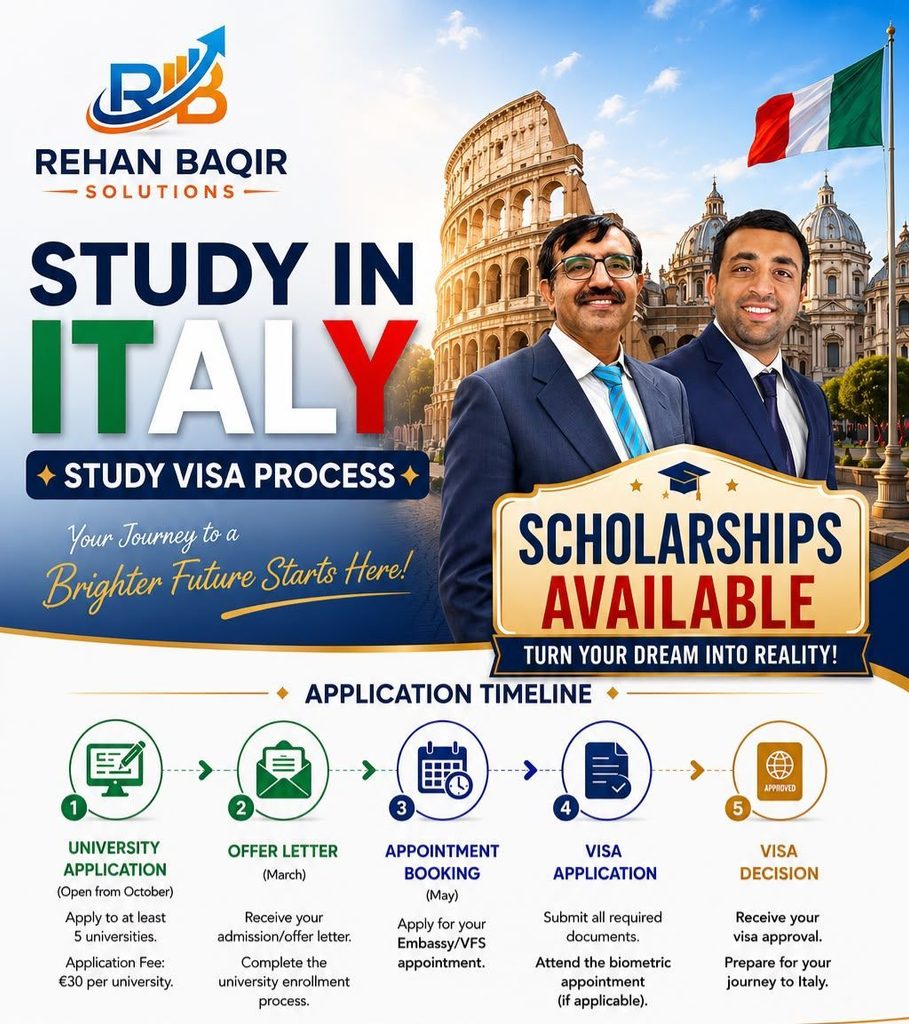
📅 September 2027 Intake – Suggested Timeline
🟢 2026 – Start Preparation
Begin your:
- Profile assessment
- University research
- Programme selection
- Document preparation
- IELTS preparation
- Financial planning
- Scholarship planning
🟢 Late 2026 / Early 2027 – Apply for Admission
Submit applications according to individual university deadlines.
🟢 Early/Mid 2027 – Admission Stage
Receive admission decisions and complete any required university procedures.
🟢 After Admission – Universitaly
Complete your pre-enrolment and wait for the required university validation.
🟢 Visa Preparation
Prepare your:
- IELTS/language documentation
- Financial file
- Accommodation
- Insurance
- Educational documents
- Visa forms
- Supporting documents
🟢 Appointment Stage
For the current Pakistan process, students whose Universitaly pre-enrolment has been confirmed can be contacted by BLS for the study visa appointment.
🟢 September 2027 – Fly to Italy 🇮🇹✈️
Once your visa is approved and travel arrangements are completed, you can begin your academic journey in Italy.
❌ Common Mistakes Students Should Avoid
❌ Waiting Until 2027 to Start
Early preparation is one of the biggest advantages you can give yourself.
❌ Applying Randomly
Choose universities according to your academic profile.
❌ Ignoring IELTS Until the Last Moment
Complete your IELTS before the Embassy appointment.
❌ Showing Unexplained Funds
Your financial documents should be genuine and consistent.
❌ Buying a Visa Appointment
The Italian Embassy has clearly warned that appointments should never be purchased.
❌ Using Fake Documents
Never submit forged or misleading documents.
❌ Assuming Admission Means Visa Approval
Admission and visa approval are separate decisions.
🚀 Planning for Italy September 2027?
Don’t Leave Your Future to Chance. Start Early.
Your Italy study journey involves much more than simply submitting a university application.
From profile assessment and university selection to admission processing, scholarship guidance, Universitaly, financial documentation, visa preparation and interview preparation, every stage needs proper planning.
🎯 Our Professional Services Include:
✅ Profile Assessment
✅ University & Programme Selection
✅ Admission Application Processing
✅ Document Guidance
✅ Scholarship Guidance
✅ Universitaly Guidance
✅ Financial Document Guidance
✅ Visa File Preparation
✅ Appointment Process Guidance
✅ Embassy Interview Preparation
✅ Pre-Departure Guidance
Plan Early. Apply Smart. Prepare Professionally.
If your target is the September 2027 Intake, don’t wait until the last moment.
Start your preparation in 2026 and give your Italy study plan the professional attention it deserves.
📢 Important Disclaimer
This article is intended for general information and planning purposes for Pakistani students.
University admission decisions are made by individual universities. Scholarship decisions are made by the relevant authorities, and visa decisions are made by the competent Italian authorities.
Admission, scholarship and visa approval cannot be guaranteed.
Visa procedures, financial requirements, university deadlines, fees, appointment procedures and immigration regulations may change. Students should always verify the latest official requirements before submitting their applications.
For the current Pakistan appointment procedure, follow the official instructions of the Italian Embassy and BLS-Intiana. The Embassy specifically advises applicants not to purchase appointments from intermediaries.
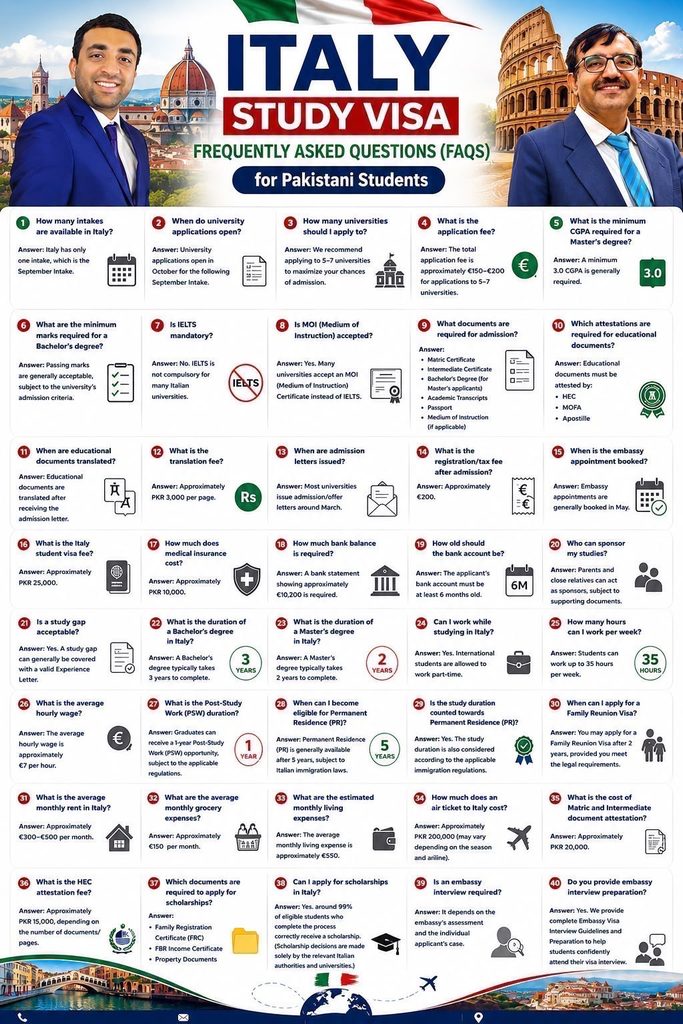
❓ 40 Frequently Asked Questions – Study in Italy for Pakistani Students
1. How many intakes are there in Italy?
September is the main intake for many Italian universities and programmes, although intake availability can vary depending on the university and programme.
2. When do Italian university applications open?
For many programmes, applications for the following September intake may begin around October, but the exact opening date depends on the university and programme.
3. How many universities should I apply to?
There is no fixed number that applies to every student. A strategic selection of several suitable universities and programmes is generally better than applying randomly.
4. What is the application fee for Italian universities?
Application fees vary by university. The approximate figure shown in the provided information is around €150–€200 for applications to 5–7 universities, but actual fees depend on the universities selected.
5. What is the minimum GPA required for a Master’s?
There is no universal 3.0 GPA rule for every Italian university. Requirements depend on the university, programme and applicant’s academic background.
6. What are the minimum marks required for Bachelor’s admission?
Requirements vary by university and programme. Students should check the eligibility criteria of their selected programme.
7. Is IELTS mandatory for Italy?
IELTS requirements depend on the university and programme. However, students should complete IELTS before their Embassy/visa appointment where it is required for their case.
8. Is MOI accepted in Italy?
Many universities may accept a Medium of Instruction (MOI) certificate, but this depends on the individual university and programme.
9. What documents are required for admission?
Common documents may include:
- Matric Certificate
- Intermediate Certificate
- Bachelor’s Degree for Master’s applicants
- Academic Transcripts
- Passport
- MOI/language proof where applicable
Additional documents may be required depending on the university.
10. Do educational documents need attestation?
Depending on the university and visa process, educational documents may require appropriate attestation, authentication and translation.
11. When should educational documents be translated?
Translation should be completed according to the requirements of the university and visa authorities. Students should not wait until the last moment.
12. How much does translation cost?
The approximate figure provided in the original information is around PKR 3,000 per page, but actual charges vary according to the translator, document and required certification.
13. When are admission letters usually issued?
Many universities may issue admission decisions around March, but the exact timing varies by university and programme.
14. Is there any registration or tax fee after admission?
Some universities may require additional registration or administrative fees. The approximate figure shown in the provided information is around €200, but actual charges vary.
15. When is the Italy Embassy appointment booked?
The current process is different from simply booking a fixed appointment month. After the required Universitaly pre-enrolment is confirmed/validated, BLS may contact eligible study visa applicants regarding the appointment.
16. How much is the Italy student visa fee?
Visa fees can change. For September 2027 applicants, the latest official fee should be checked before submitting the application.
17. How much does medical insurance cost?
The cost depends on the insurance provider, coverage and duration. Students should purchase a policy that meets the current visa requirements.
18. How much bank balance is required?
Students need to demonstrate sufficient financial resources according to the applicable Italian requirements. The amount can change, so students should verify the current requirement at the time of visa application.
19. How old should the bank account be?
Students should maintain a genuine and properly documented financial history. The current Embassy checklist requires bank statements covering the specified period.
20. Who can sponsor a student?
Parents and eligible close relatives may be able to provide financial support, subject to the applicable requirements and supporting documents.
21. Can I study in Italy with a study gap?
Yes, a study gap does not automatically prevent admission. Students should properly explain and document their gap.
22. What is the duration of a Bachelor’s degree?
Many Bachelor’s programmes in Italy are typically 3 years, although programme structures can vary.
23. What is the duration of a Master’s degree?
Many Master’s programmes are typically 2 years, depending on the programme and university.
24. Can international students work while studying?
Yes. International students can work subject to the applicable Italian regulations.
25. How many hours can students work per week?
Current government guidance allows student residence permit holders to work up to 20 hours per week and 1,040 hours per year in subordinate employment.
26. What is the average hourly wage in Italy?
The hourly wage varies according to the job, location, employer and employment contract. The approximate €7/hour figure from the provided image should therefore be treated only as a general estimate, not a guaranteed wage.
27. Is there a post-study work opportunity?
Graduates may have options to remain in Italy for employment depending on their qualification, employment situation and the immigration rules applicable at that time.
28. Can students get Permanent Residence in Italy?
Eligible foreign nationals may qualify for long-term residence under Italian law, but it is not automatic and depends on the applicable requirements and residence status.
29. Does study duration count toward Permanent Residence?
The treatment of study residence for long-term residence purposes depends on the applicable Italian immigration rules and the type of permit. Students should verify their individual situation.
30. Can students bring their family to Italy?
Eligible residents may have family reunification options, subject to the applicable immigration requirements.
31. How much is the average monthly rent?
The approximate figure provided is €300–€500 per month, but actual rent can vary significantly depending on the city, location and accommodation type.
32. How much are monthly groceries?
A planning estimate of around €150 per month is often used, but actual expenses depend on lifestyle, city and shopping habits.
33. What is the estimated monthly living cost?
The approximate figure shown in the provided information is around €550 per month, but actual living expenses can be higher or lower depending on accommodation and lifestyle.
34. How much does an air ticket to Italy cost?
The approximate figure provided is around PKR 200,000, but airfare changes according to airline, route, booking date and travel season.
35. How much does Matric/Intermediate document attestation cost?
The approximate figure provided is around PKR 20,000, but actual costs depend on the documents and current official charges.
36. How much does HEC attestation cost?
The approximate figure provided is around PKR 15,000, depending on the documents and number of pages/services required. Students should confirm the latest official charges.
37. What documents are required for scholarships?
Commonly requested financial/family documents may include:
- Family Registration Certificate (FRC)
- FBR/Income Certificate
- Property Documents
- Family financial information
Exact requirements depend on the scholarship authority.
38. How many students get scholarships in Italy?
Scholarships are available to many eligible international students, but there is no reliable universal figure such as 99% for every applicant. Eligibility depends on the scholarship programme, region, university, financial situation and required criteria.
39. Is an Embassy interview required?
An interview or personal appearance may be requested depending on the applicant’s case and the Embassy’s assessment.
40. Can I prepare for the Embassy interview?
Yes. Proper interview preparation is highly recommended.
Students should understand:
- Why they selected Italy
- Why they selected their university
- Why they selected their programme
- Their previous education
- Their future plans
- Their financial arrangements
- Their accommodation
- Their study plans
- Their career goals
Students should always answer honestly and confidently.