
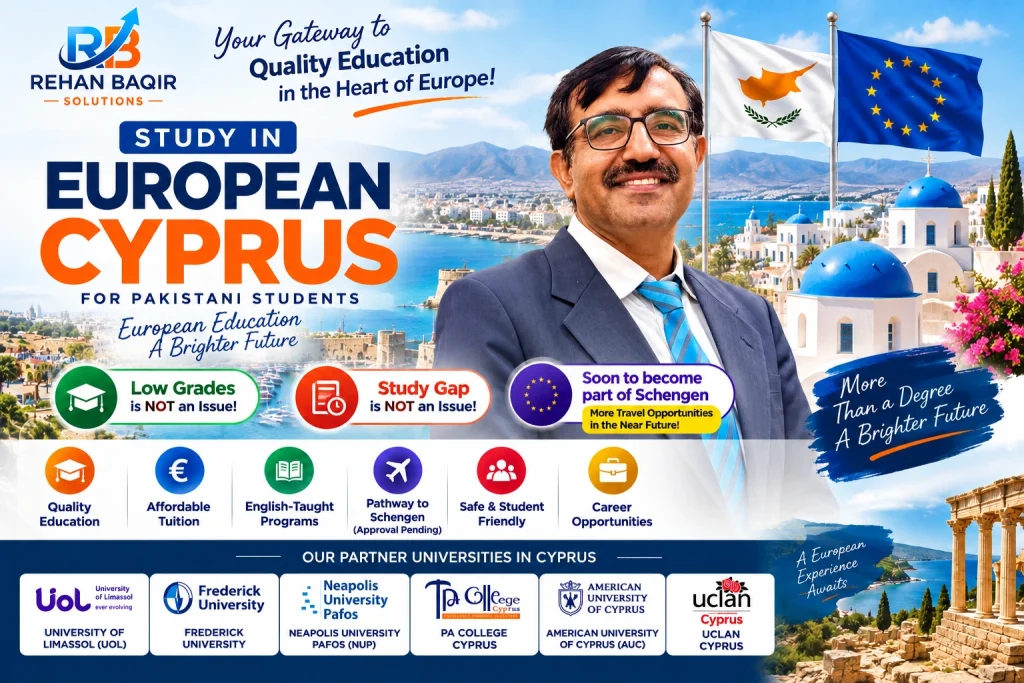
If you are looking for a European study destination that offers EU membership, quality education, English-taught programs, affordable study options and an international environment, European Cyprus deserves serious consideration.
Cyprus has been a member of the European Union since 2004, giving international students the opportunity to study within an established EU member country while experiencing its Mediterranean lifestyle and multicultural environment.
For Pakistani students, European Cyprus can be an attractive option for building an international academic and professional future.
Why Choose European Cyprus?
Cyprus combines European education with a welcoming environment for international students. Students can explore programs in fields such as:
- Business and Management
- Computing and Information Technology
- Engineering
- Finance
- Psychology
- Data Analytics
- Hospitality
- Economics
- Other professional and academic disciplines
Many programs are available in English, making Cyprus particularly suitable for Pakistani students.
Cyprus Is Part of Europe and the European Union
One of the most important advantages of Cyprus is that it is already part of the European Union.
Cyprus became an EU Member State in 2004. Students choosing Cyprus are therefore choosing an established European Union destination.
For Pakistani students, studying in an EU country can provide valuable international exposure and the opportunity to experience European academic and professional environments.
It is important to understand that EU membership and Schengen membership are two different things. Cyprus is already an EU member, while its full accession to the Schengen Area is still in progress.
Cyprus and the Schengen Area
The future of Cyprus within the Schengen Area is an important development for students considering the country.
Cyprus is not yet a full member of the Schengen Area, but the country has made significant progress toward joining.
The technical process has progressed considerably, while the remaining political and formal approvals are still required before Cyprus officially becomes part of Schengen.
For students, the important point is simple: Cyprus is already part of the European Union, while its Schengen membership is still pending.
The expected progress toward Schengen membership makes Cyprus an increasingly interesting destination for students planning their European education journey.
Quality Education in European Cyprus
Cyprus has developed a strong higher-education sector with universities and institutions offering programs for both local and international students.
Students can choose undergraduate and postgraduate programs according to their interests, previous education and career objectives.
Studying in Cyprus also gives students an opportunity to become part of an international academic environment and interact with people from different countries.
English-Taught Programs
For Pakistani students, the availability of English-medium education is a major advantage.
Students can find English-taught programs in areas such as:
Business and Management
Computing and IT
Engineering
Psychology
Hospitality
Finance
Data Analytics
Economics and related disciplines
This allows students to continue their higher education in an international environment with English as the primary language of instruction.
Universities and Institutions in Cyprus
Students can explore a number of universities and institutions in Cyprus.
Options presented by Rehan Baqir Solutions include:
- University of Limassol
- Frederick University
- Neapolis University Pafos
- PA College Cyprus
- American University of Cyprus
- UCLan Cyprus
Each institution has its own programs, admission criteria, tuition structure and English-language requirements.
Choosing the right university should therefore depend on your academic background, preferred field, budget and future career plans.
No Low Grades Issue
Students often worry that their academic results may limit their options for studying abroad.
In Cyprus, students can explore different universities and programs according to their individual academic profiles. Admission requirements vary between institutions and programs, so the right approach is to assess your complete academic background rather than assuming that one particular grade automatically prevents you from studying in Cyprus.
A proper profile assessment can help identify suitable programs and institutions.
No Study Gap Issue
A study gap does not automatically mean that you cannot pursue higher education in Cyprus.
Students with previous gaps in their education can explore suitable options based on their academic and professional history.
The important thing is to present your educational and professional journey clearly and provide appropriate supporting documentation where required.
Affordable European Education
For many Pakistani students and families, affordability is an important factor when choosing a European study destination.
Cyprus provides students with an opportunity to explore European education with comparatively accessible tuition and living options.
The total cost depends on the university, program, accommodation and personal lifestyle.
Proper financial planning before starting the application process is therefore essential.
A Safe and Student-Friendly Environment
Cyprus provides an attractive environment for international students.
Students can experience Mediterranean culture, modern cities, beautiful coastal surroundings and an international community.
For Pakistani students travelling abroad, adapting to a new environment is an important part of the international education experience, and Cyprus can provide an interesting setting for both academic and personal development.
Work Opportunities During Studies
International students may be permitted to work part-time during their studies, subject to the applicable rules and regulations in Cyprus.
Part-time work can provide students with valuable practical exposure and help them develop communication, workplace and professional skills.
Students should always follow the current employment conditions applicable to their student status.
Scholarships and Financial Opportunities
Scholarship opportunities may be available at selected universities and for specific programs.
Scholarship availability, eligibility and award amounts can vary between institutions and academic programs.
Students should therefore explore the scholarship options associated with their chosen university and intake before making financial decisions.
Admission After Intermediate or HSSC
Students who have completed Intermediate, HSSC or an equivalent qualification can explore suitable undergraduate and foundation programs in Cyprus.
Admission requirements vary depending on the university and selected program.
The academic background, subjects studied and English-language requirements may all be considered during the admission process.
Master’s Programs in Cyprus
Students who have completed a relevant Bachelor’s degree can explore Master’s programs in Cyprus.
Master’s options are available across a variety of fields, allowing graduates to continue their education and develop specialized knowledge.
The eligibility criteria depend on the selected university and program.
Why European Cyprus Can Be a Smart Choice for Pakistani Students
European Cyprus brings together several important advantages:
EU Membership
English-Taught Education
International Universities
No Automatic Rejection Because of a Study Gap
Multiple Academic Options
Affordable Study Opportunities
Student-Friendly Environment
European Exposure
Career Development Opportunities
Progress Toward Schengen Membership
For students who want to begin their European education journey in an EU country, Cyprus deserves serious consideration.
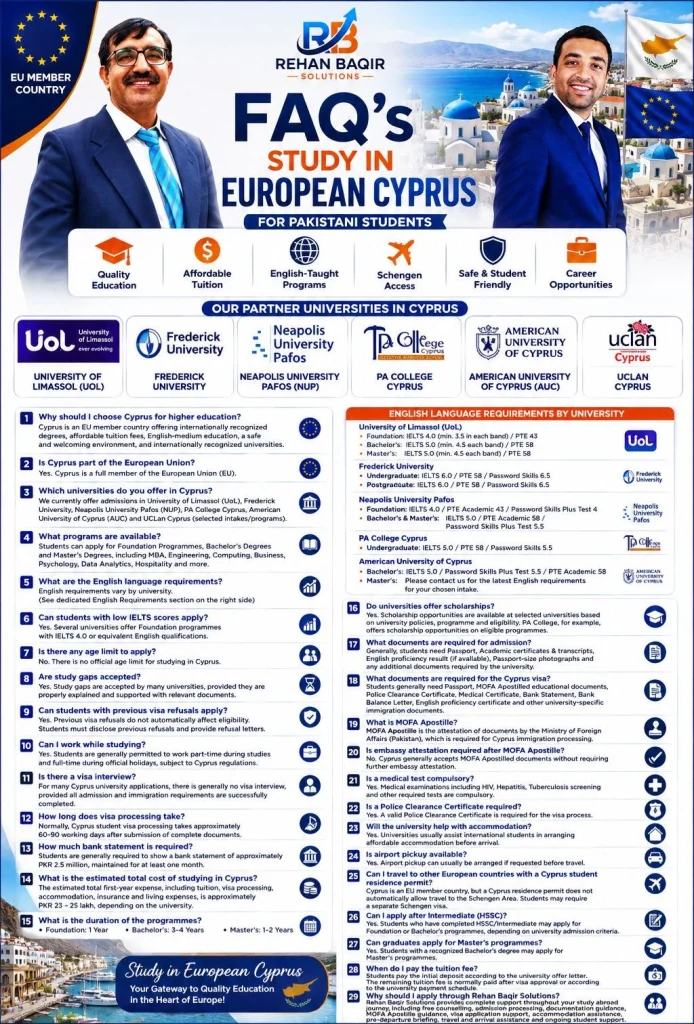
Frequently Asked Questions – Study in European Cyprus
1. Why should I choose Cyprus for higher education?
Cyprus is an EU Member State offering internationally oriented education, English-medium programs, a welcoming environment, comparatively accessible tuition options and opportunities for international exposure.
2. Is Cyprus part of the European Union?
Yes. Cyprus is a full member of the European Union and joined the EU in 2004.
3. Which universities do you offer in Cyprus?
The options presented by Rehan Baqir Solutions include University of Limassol, Frederick University, Neapolis University Pafos, PA College Cyprus, American University of Cyprus and UCLan Cyprus, subject to available programs and intakes.
4. What programs are available?
Students can explore Foundation, Bachelor’s and Master’s programs in fields including Engineering, Computing, Business, Psychology, Data Analytics, Hospitality, Management and other disciplines.
5. What are the English-language requirements?
English requirements vary by university and program. Depending on the institution, students may be able to apply with IELTS, PTE or other accepted English-language qualifications.
6. Can students with low IELTS scores apply?
Some universities and programs may accept students with comparatively lower English-language scores or offer foundation routes, depending on their admission requirements.
7. Is there any age limit to apply?
There is generally no single universal age limit for studying in Cyprus. However, individual universities and programs may have their own admission requirements.
8. Are study gaps accepted?
Yes. Study gaps may be considered by universities when the student’s academic and professional history is properly explained and supported with relevant documentation.
9. Can students with previous visa refusals apply?
A previous visa refusal does not automatically make a student ineligible. Each application is assessed according to its circumstances, and previous refusals should be properly disclosed and addressed where required.
10. Can I work while studying?
Students may be permitted to work part-time during their studies, subject to the applicable Cyprus regulations.
11. Is there a visa interview?
The admission and visa process depends on the university, application and current requirements. Students should be prepared for any additional verification or interview if requested.
12. How long does Cyprus visa processing take?
Processing time can vary depending on the application, documentation, university and relevant authorities. Students should apply well in advance.
13. How much bank statement is required?
The required financial evidence depends on the student’s circumstances and current requirements. Students should demonstrate sufficient funds to support their education and living expenses.
14. What is the estimated total cost of studying in Cyprus?
The total cost depends on tuition fees, accommodation, visa processing, insurance, living expenses and other personal costs.
15. What is the duration of the programs?
Program duration depends on the level and field of study. Foundation, Bachelor’s and Master’s programs have different durations according to the selected institution and course.
16. Do universities offer scholarships?
Yes. Scholarship opportunities may be available at selected universities and for eligible programs. Availability and eligibility vary by institution.
17. What documents are required for admission?
Students generally need a valid passport, academic certificates and transcripts, photographs and other documents required by the selected university and program.
18. What documents are required for the Cyprus visa?
Visa documentation can include a passport, academic documents, photographs, financial evidence, medical documents, police clearance and other documents required for the student’s specific case.
19. What is MOFA Apostille?
MOFA Apostille refers to the authentication or apostille process through the relevant Ministry of Foreign Affairs for documents that require international legalization or recognition.
20. Is embassy attestation required after MOFA Apostille?
Requirements can depend on the type of document and the current procedure. Students should follow the applicable requirements for their particular Cyprus application.
21. Is a medical test required?
Yes. Medical examinations and relevant health tests may be required as part of the Cyprus student immigration process.
22. Is a Police Clearance Certificate required?
Yes. A Police Clearance Certificate can be required as part of the student visa and immigration documentation.
23. Will the university help with accommodation?
Universities may provide assistance or guidance to international students regarding accommodation. Availability and arrangements differ between institutions.
24. Is airport pickup available?
Airport pickup may be arranged in certain cases, depending on the university, accommodation arrangements and services available for international students.
25. Can I travel to other European countries with a Cyprus student residence permit?
Cyprus is an EU country but is not yet fully part of the Schengen Area. A Cyprus student residence permit therefore does not currently provide automatic visa-free travel throughout the Schengen Area.
Cyprus is progressing toward Schengen integration, with the remaining political and formal approval process still pending.
26. Can I apply after Intermediate or HSSC?
Yes. Students who have completed Intermediate, HSSC or an equivalent qualification can explore Foundation and Bachelor’s programs according to the admission criteria of the selected university.
27. Can graduates apply for Master’s programs?
Yes. Students with a relevant Bachelor’s degree can explore Master’s programs according to the admission requirements of their selected university.
28. When do I pay the tuition fee?
Tuition payment arrangements depend on the university and offer letter. Students should follow the payment schedule provided by their selected institution.
29. Why should I apply through Rehan Baqir Solutions?
Rehan Baqir Solutions can provide professional support throughout the study-abroad journey, including university and program selection, admission application support, documentation guidance, visa preparation, MOFA Apostille guidance, pre-departure preparation, travel assistance and ongoing student support.
Start Your European Education Journey
European Cyprus gives Pakistani students the opportunity to pursue higher education in an EU Member State with English-taught programs, international exposure, diverse academic options and a student-friendly environment.
With no automatic barrier because of a study gap, multiple academic options, English-medium education and continued progress toward Schengen integration, Cyprus can be an attractive destination for students planning their future.
Cyprus is already part of the European Union, while its journey toward full Schengen integration continues.
If your goal is to study in Europe, European Cyprus is a destination worth exploring.