
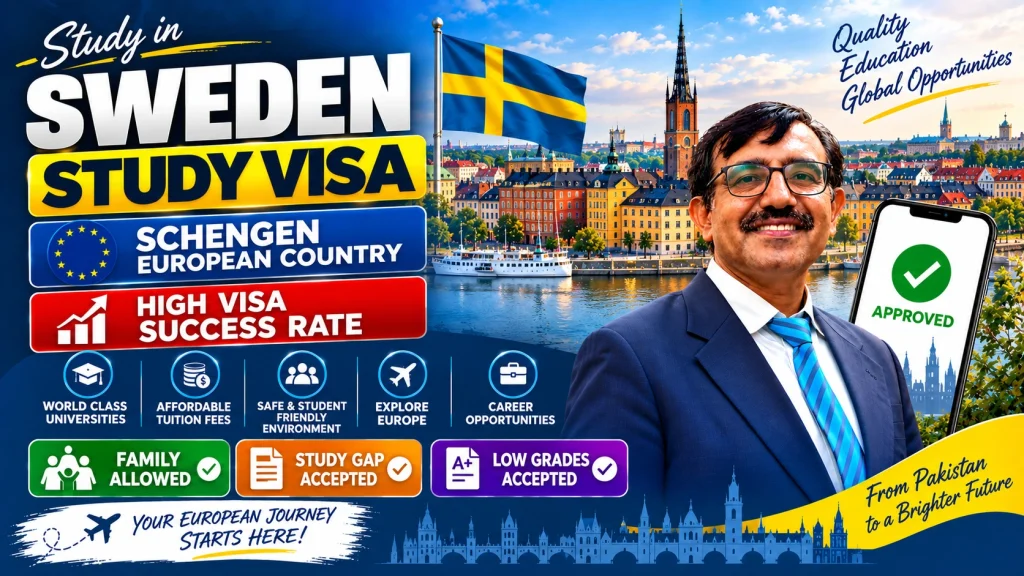
Study in Sweden in 2027 – Your Complete Guide to Admission, Costs, Documents, Bank Statement & Residence Permit
Sweden continues to attract international students who are looking for high-quality education, internationally recognised degrees, innovative learning environments and strong career opportunities in Europe. For Pakistani students planning to study abroad, the September 2027 Intake in Sweden is an excellent opportunity to start a new academic and professional journey.
The Swedish education system places strong emphasis on practical learning, independent thinking, innovation, research and interaction between students and teachers. Many Swedish universities offer Bachelor’s and Master’s programmes taught completely in English, which means international students can pursue their education without needing to learn Swedish before starting their studies.
However, getting admission to a Swedish university is only one part of the process. Students must also carefully plan their tuition fee, application documents, financial requirements, residence permit application and overall budget.
This complete guide explains the Sweden September 2027 Intake, including admission timelines, eligibility, tuition fees, application costs, required documents, financial requirements, family applications, residence permits and the step-by-step process for Pakistani students.
🎥 Watch Our Complete Sweden Study Visa Guide for September 2027
👍 If you find this guide helpful, please Like the video, Share it with friends and family who are planning to study in Sweden, and leave a Comment with your questions or feedback. Your support helps us reach and guide more students!
Why Choose Sweden for Higher Education?
Sweden offers a unique combination of academic quality, innovation, international exposure and a high standard of living. Swedish universities are known for encouraging students to think independently rather than simply memorising information. The teaching approach often includes projects, presentations, research, teamwork and practical problem-solving.
For international students, another major advantage is the availability of English-taught programmes. Students can find a wide range of programmes in areas such as business, management, engineering, computer science, information technology, artificial intelligence, data science, sustainability, finance, economics, healthcare and other specialised fields.
Sweden is also part of the European higher education environment, giving graduates international exposure and access to a highly developed European economy. For students who are serious about building an international academic and professional career, Sweden can therefore be a strong study destination.

Sweden September 2027 Intake – When Should You Start?
Students interested in the September 2027 Intake should start preparing well before the application portal opens. Waiting until the final deadline can create unnecessary problems because students may need time to select suitable programmes, arrange academic documents, complete English-language requirements, prepare financial documentation and submit a complete application.
The first international application round for the Autumn 2027 semester will open on 16 October 2026. The application deadline is 15 January 2027. Students must submit all required documents by 2 February 2027. Master’s admission results will be released on 26 March 2027, while Bachelor’s admission results will be released on 31 March 2027.
A student planning for September 2027 should ideally begin preparation as early as possible rather than waiting until January 2027.

Sweden September 2027 Intake – Application Timeline
The Swedish international admission cycle follows a structured timeline. Based on the currently published annual schedule, applicants should the September 2027 cycle to follow approximately the same pattern.
October 2026 – Applications Open
The international application round for the Autumn 2027 semester opens on 16 October 2026. Students can begin submitting applications for eligible programmes from this date.
15 January 2027 – Main Application Deadline
The first international application round closes on 15 January 2027. Applicants must submit their programme choices and rank them correctly because programme ranking can affect the admission outcome.
2 February 2027 – Application Fee Deadline
The application fee must be paid by 2 February 2027. Applicants should complete payment before the deadline to ensure that their application is processed.
2 February 2027 – Supporting Documents Deadline
All supporting documents must be submitted by 2 February 2027. Students should not leave document submission until the last day because missing or incorrectly submitted documents can affect the application.
March 2027 – Admission Results
For the first international admission round, Master’s admission results are normally released in late March, followed by Bachelor’s results. The currently published schedule shows 26 March for Master’s and 31 March for Bachelor’s programmes.
April–July 2027 – University & Residence Permit Stage
After receiving an admission offer, students need to complete the next stages, including tuition-fee payment where applicable and preparation of the Swedish residence permit application.
August/September 2027 – Arrival & Semester Start
The Autumn semester normally begins in August or September. Students should arrange accommodation, travel and other preparations well in advance.
Important: The exact September 2027 dates should always be confirmed from the official University Admissions schedule once the 2027 calendar is published.

Who Can Apply for a Sweden Study Visa?
Students from countries outside the EU/EEA who want to study a full-time higher-education programme in Sweden generally need a residence permit for studies. Admission alone does not automatically give a student the right to enter and remain in Sweden for the purpose of study.
The Swedish Migration Agency requires the student to have a valid passport and final admission to full-time studies. Tuition fees must also be paid before the residence permit can be granted.
The applicant must also demonstrate sufficient financial means (Bank Statement) to support themselves during the period for which the residence permit is requested.

Study Programmes Available in Sweden
Swedish universities offer programmes across a broad range of academic disciplines. International students can explore English-taught options in areas such as:
- Business Administration
- International Business
- Finance
- Accounting
- Economics
- Marketing
- Management
- Computer Science
- Information Technology
- Artificial Intelligence
- Data Science
- Software Engineering
- Cybersecurity
- Engineering
- Renewable Energy
- Environmental Studies
- Sustainability
- Supply Chain Management
- Project Management
- Public Health
- Biotechnology
- Other specialised Master’s programmes
The most suitable programme depends on the applicant’s previous education, academic background, work experience where relevant and future career objectives.
Students should avoid selecting a programme simply because it appears easy to obtain admission to. A strong application normally begins with choosing a programme that logically connects the applicant’s previous studies and future career plans.

How Many Programmes Can You Apply For?
Swedish University Admissions allows applicants to rank multiple programmes according to their preference. For Master’s applications, students can apply for up to four programmes in each admission round, while Bachelor’s applicants can apply for up to eight programmes. The ranking order is important because admission decisions are made according to the applicant’s ranking and eligibility.
This makes programme selection an important part of the overall strategy. Instead of randomly selecting programmes, students should carefully evaluate eligibility requirements, previous education, academic subjects, English-language requirements and career relevance before submitting their choices.
We carefully assess each student’s academic background, previous subjects, grades, English-language proficiency, study gap, work experience and career goals before recommending suitable programmes. We compare the student’s profile with the specific entry requirements of different Swedish universities and help create a balanced programme selection strategy. This may include prioritising programmes where the student has a strong academic match, selecting realistic alternatives and ensuring that the chosen courses are relevant to the student’s previous education and future plans. This careful approach helps students avoid unsuitable applications and can improve the overall strength and potential of their admission applications.

Sweden University Tuition Fees for International Students
Students from outside the EU/EEA and Switzerland are generally required to pay tuition fees for Swedish higher education, although the exact amount depends on the university and programme.
Based on the programme information used in our current guidance, students should generally keep a budget of approximately SEK 50,000–82,000 per semester for tuition, although actual tuition fees can be significantly different depending on the selected programme and university.
In Pakistani Rupees, this can represent a substantial investment, so students should check the exact tuition fee for their selected programme before making financial arrangements.
Tuition fees are separate from living expenses, application fees, residence permit costs, travel expenses and other personal expenses.

Sweden University Application Fee
For applicants who are required to pay the application fee, the current University Admissions application fee is SEK 900. This is an official application fee and should not be confused with consultancy or admission-processing charges.
The amount in Pakistani Rupees may vary depending on the exchange rate and payment method used at the time of payment.

Sweden Study Visa – Financial Requirement & Bank Statement
One of the most important parts of the Swedish residence permit process is demonstrating sufficient financial maintenance.
For applications made in 2026, the Swedish Migration Agency states a maintenance requirement of SEK 10,656 per month for the student. If a student applies for a longer permit period, the total amount is calculated according to the number of months for which financial maintenance must be demonstrated.
For example:
13 months:
SEK 10,656 × 13 = SEK 138,528
24 months:
SEK 10,656 × 24 = SEK 255,744
Using an illustrative exchange rate of 1 SEK = PKR 30, these amounts are approximately:
13 months: PKR 4,155,840
24 months: PKR 7,672,320
These PKR figures are only illustrative because exchange rates change. More importantly, the financial requirement applicable to a September 2027 application may be different from the 2026 amount. Students should therefore verify the applicable amount with the Swedish Migration Agency at the time of their residence permit application.
Financial Requirement for Husband, Wife and Children
Students who plan to travel with their family need to demonstrate additional financial maintenance.
Under the current Swedish Migration Agency rules, the additional amount is SEK 4,440 per month for a spouse/cohabiting partner and SEK 2,664 per month for each child.
For example, under the current 2026 rates, a family consisting of:
Husband + Wife:
SEK 10,656 + SEK 4,440 = SEK 15,096 per month
Husband + Wife + 1 Child:
SEK 10,656 + SEK 4,440 + SEK 2,664 = SEK 17,760 per month
Husband + Wife + 2 Children:
SEK 10,656 + SEK 4,440 + SEK 2,664 + SEK 2,664 = SEK 20,424 per month
The exact amount required for a 2027 application should be confirmed according to the financial-maintenance rates applicable when the residence permit application is submitted.

Documents Required for Sweden Study Admission
A successful application depends heavily on accurate and complete documentation. Typical documents may include:
- National Identity Card/CNIC
- Valid Passport
- Academic Degrees
- Academic Transcripts/Mark Sheets
- English-language test result where required
- CV/Europass CV
- Recommendation Letters where required
- Programme-specific documents
- Other documents required by the selected university or programme
Documents should be clear, complete and submitted according to the requirements of the selected programme.
Applicants should also carefully check whether their academic documents require attestation or verification. The exact requirement can vary according to the applicant’s educational background and the programme/university involved.

English Language Requirements for Sweden
For most English-taught Bachelor’s and Master’s programmes in Sweden, the required level is English 6. Students can demonstrate this through an accepted English-language test. The three commonly used options are IELTS Academic: overall 6.5 with no section below 5.5; TOEFL iBT: total 4.5 on the new 1–6 scale, with no section below 4; and PTE Academic: overall 62, with at least 61 in Writing. IELTS General Training and IELTS Indicator are not accepted. For Pakistani students, English studied at school is generally not sufficient by itself, so an approved English test is normally required. However, IELTS itself is not mandatory—students can use another accepted test such as TOEFL or PTE, provided they meet the required score.

Can You Bring Your Spouse and Children to Sweden?
es. Under the current rules, certain family members of a student holding or applying for a residence permit for higher education can apply for residence permits as accompanying family members.
The Swedish Migration Agency defines eligible family members in this context as spouses, cohabiting partners, registered partners and unmarried children under 18.
However, accompanying family members create additional financial and documentation requirements. The student must therefore plan the financial side of the application carefully.
Family members also need to provide documents proving the relationship, such as marriage or birth documentation where applicable.

Can Students Work in Sweden During Their Studies?
This is an area where students should be especially careful because Swedish rules changed in 2026.
For residence permits granted under the new rules, students at Bachelor’s or Master’s level are generally limited to 15 hours of work per week during semesters. During June, July and August, the rules allow work without this weekly limitation.
However, the student’s spouse has full working rights in Sweden and is not subject to the student’s 15-hour weekly work limitation.
Therefore, students should not build their financial plan around an assumption of unlimited part-time work. The spouse’s employment rights may provide an additional source of household income.
The primary financial requirement for the residence permit should be arranged before applying, rather than relying on future employment in Sweden to meet the initial maintenance requirement.

Post-Study Opportunities in Sweden
Sweden can offer international graduates opportunities to continue developing their careers after completing higher education. However, students should distinguish between a study residence permit and any later residence permit they may qualify for.
Eligible international graduates may be granted a residence permit for up to one year after completing their studies to look for employment or explore opportunities to start a business in Sweden. If a graduate secures a job that meets the applicable minimum salary and other requirements, they may be eligible to apply for a work residence permit and continue staying in Sweden. The requirements and applicable rules should be checked with the Swedish Migration Agency at the time of application, as immigration regulations and salary thresholds may change.
Students should therefore select their programme not only according to admission possibilities but also according to their long-term academic and professional goals.

Sweden Study Visa – Important Mistakes to Avoid
One of the biggest mistakes students make is applying without properly checking programme eligibility. A programme may appear attractive but still not be suitable because of specific academic prerequisites.
Another common mistake is leaving document preparation until the deadline. A missing transcript, incorrect document, incomplete application or failure to meet a programme-specific requirement can create serious problems.
Students should also avoid relying on outdated information from social media. Swedish immigration and university admission rules can change, particularly financial requirements and residence permit conditions.
Finally, students should never treat the bank statement as a formality. Financial maintenance is an important part of the residence permit application and should be prepared according to the Swedish Migration Agency’s requirements.

Why Start Your Sweden 2027 Application Early?
A successful Swedish study application is not simply about submitting an online form. It requires proper planning from academic assessment through university selection, document preparation, admission, tuition payment, financial planning and residence permit processing.
Starting early gives you time to identify the right programme, correct weaknesses in your profile, prepare financial documents and avoid last-minute pressure.
For students targeting the September 2027 Intake, the preparation period should begin well before the application deadline.

Start Your Sweden September 2027 Journey Today
If Sweden is part of your study-abroad plans for 2027, now is the right time to start preparing.
At NoumanAfzal.com, our objective is to help students understand the complete process before making important academic and financial decisions. From profile assessment and programme selection to admission processing and residence permit guidance, every stage should be approached with proper planning and up-to-date information.
Your Swedish study journey starts with choosing the right programme, preparing the right documents and planning the process at the right time.
Plan Early. Prepare Properly. Study in Sweden in 2027.
Important Disclaimer: Admission decisions are made by Swedish universities, while residence permit decisions are made by the Swedish Migration Agency. Requirements, fees, financial-maintenance amounts, processing procedures and immigration rules can change. All applicants should verify the latest official requirements before submitting an application.
Here are some Frequently Asked Questions for you, read carefully.

FAQs for Sweden – Study Admission
1. Why choose Sweden for higher studies?
Sweden offers world-class education, innovative teaching, high quality of life, post-study work opportunities, and a pathway to permanent residency.
2. Can I bring my family while studying?
Yes! Your spouse and children under 18 can accompany you. Your spouse can work full-time and children receive free education.
3. Can I work while studying?
Yes! You can work 15 hours per week while studying.
4. Is there a post-study work visa?
Yes! 12-month job search visa after graduation or masters.
5. How to get permanent residence (PR)?
You can apply for PR after 5 years of continuous residence (study + work) as per current laws.
Important: Swedish Passport / Citizenship can be applied after 8 years of residence as per new rules.
6. Are study gaps acceptable?
Yes! Study gaps are generally not an issue. However you need to justify your study gap with experience letter.
7. Can I get admission with low grades?
Some universities may accept lower grades with strong motivation letters/relevant experience.
8. What are tuition fees?
50,000–82,000 SEK per semester
(≈ 15 Lacs to 26 Lacs per semester at 28 PKR/SEK).
9. Bank balance requirement for visa?
- 10,656 SEK/month for 13 months: 138,528 SEK (4.2 million PKR approx.) for single applicant.
- If Spouse is accompanying main applicant, then 4,440 SEK/month for 13 months: 57,720 SEK (1.9 million PKR approx.).
- If Children are accompanying as well, then 2,664 SEK/month. For 13 months: 34,632 SEK (1 million PKR approx.) per child.
10. English-taught programs available?
Yes! Hundreds of programs at bachelor’s/master’s level – no Swedish required.
11. Can I work with only English?
Yes! 90% of Swedes speak English. Many jobs in tech/business don’t require Swedish. But its better to learn Swedish.
12. Benefits of living in Sweden?
Free healthcare, free education for kids, high salaries, great work-life balance, and strong social welfare.
13. Family benefits?
Children get free top-quality education. Spouse can work full-time. Generous parental leave (see Q17).
14. Pension benefits?
Strong pension system with healthcare and social security for retirees.
15. Schengen travel benefits?
Swedish residence permit allows visa-free travel to 26 Schengen countries.
16. Pathway to Europe?
Clear path to PR after 5 years and citizenship after 8 years makes Sweden an ideal gateway to Europe.
17. Accepted English tests:
- IELTS Academic
- TOEFL iBT
- PTE Academic
18. IELTS requirements:
Academic Required.
IELTS:
- Overall 6.5
- No section <5.5
19. TOEFL requirements:
- English 6: 90 total (20 writing)
20. PTE requirements:
- English 6: 62 overall (writing 61)
21. Is English test must or MOI also accepted?
English test is must and MOI is not accepted in Sweden. One of the following tests are compulsory to be attempted to apply for Sweden (IELTS, PTE or TOEFL). Required results are mentioned in above questions.
22. Parental leave benefits?
480 days leave:
- 390 days at 80% salary
- 90 days at flat rate
Can be shared between parents until child turns 12.
23. How many programs can I apply to?
You can apply for up to 4 programs in each admission round for Masters and up to 8 programs for Bachelors, ranked in your order of preference.
24. Is there an application fee?
Yes – 900 SEK (≈32,000 PKR) approx for non-EU/EEA students.
25. What documents do I need to submit?
Required documents include:
- Academic transcripts/certificates
- Passport copy
- Proof of English proficiency i.e. English Test (IELTS/PTE/TOEFL)
- Program-specific requirements (portfolio, CV etc.)
26. What is Visa Fee?
Visa fee is 1500 SEK. Rs 50,000 approx.
27. What is Air Ticket Charges Approx?
Air Ticket Charges for single applicant are approx. 2 Lacs PKR.
28. What is visa ratio in Sweden?
Visa ratio in Sweden for International Students is 99%.
29. What is requirement to take admission in Bachelors?
Minimum Intermediate marks 50%, Matric and Intermediate Degrees Attested from IBCC-MOFA. Student with lower grades then 50% can also apply after discussing their case specifically with us.
30. What is requirement to take admission in Masters?
Minimum Bachelor (16 years of Education)
CGPA 2.5, Degrees Transcripts Attested from HEC. Student with lower grades i.e. below 2.5 CGPA can also apply after discussing their case specifically with us.
31. What is Processing Time for university admission?
Admission starts on 16th October and Last date to apply is on 15th Jan and Admission results are announced in April’s 1st week for September Intake.
Admission starts on 2nd June and Last date to apply is on 15th August and Admission results are announced in October’s 1st week for January Intake.
32. What documents are required?
Matric & Intermediate Degrees, Graduation & Master’s Degrees, Passport, ID card.
Any other documents if needed will be guided by us case to case basis.
33. From where these documents need to be attested?
In case of Sweden only latest degree needs to be attested. For attestation details please take clear guidance from us before getting yourself indulged in unnecessary costs.
🎓 Your Sweden Journey Starts With the Right Guidance
Planning to study in Sweden for the September 2027 Intake? Don’t leave your future to guesswork.
From profile assessment and university selection to programme research, application processing, admission confirmation and residence permit guidance, our professional team helps you navigate every important step of your Sweden study journey.
We don’t simply submit an application — we assess your profile, identify suitable programmes, guide you on the required documents and help you prepare your application professionally and strategically.
Let’s Build Your Sweden Study Plan Today
✅ Profile Assessment
✅ University & Programme Selection
✅ Complete Application Processing
✅ Document Guidance
✅ Admission Assistance
✅ Residence Permit Guidance
✅ Interview Preparation, Where Required
🚀 Don’t Wait Until the Deadline!
The September 2027 Intake preparation starts well before applications close. Starting early gives you more time to choose the right programme, prepare your documents and avoid last-minute complications.
Your dream of studying in Sweden deserves more than a random application. Give it the professional planning it deserves.
📩 Contact Us Today & Start Your Sweden 2027 Application
Nouman Afzal
Professional Study Abroad Guidance & Admission Services
Plan Early. Apply Smart. Prepare Professionally.